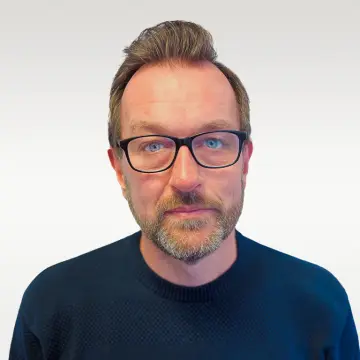
The Lalandia director is full of optimism for the future - both for the water park in Rødby and for Lolland-Falster as a whole. But danger lurks: The Fehmarn connection may be a smaller game changer than expected
- Our business model should not be that there is a huge construction going on for ten years. That would make us vulnerable afterward, says Karsten Juhl.Jonas Højlund
The gaze goes towards the brown Labrador, who happily comes over to greet. That's Brownie, who has a permanent spot in the corner of Karsten Juhl's office in Lalandia.
As the center director in Rødby, it's his responsibility to ensure that the original Lalandia runs well and develops. And it does, if you look at the numbers. It's a good business and a large and important player for tourism in and around Lolland-Falster. Previously, a 20 percent decline in tourism in the area was due to Lalandia experiencing a 20 percent decline. A role that Karsten Juhl is very aware of. Therefore, it's not enough for Lalandia in Rødby to do well. It's not enough.
- Previously, it was almost like we took the wheels off the cars when you arrived. We have everything, and you don't need to leave our area, says Karsten Juhl and quickly adds that it's not like that anymore. He is actively involved in the development of tourism on Lolland-Falster.
- We can see that people come back after they have visited us. That is, without children and not with us. But maybe a romantic getaway later. And we do a lot to highlight all the other things the area offers.
The construction of the Fehmarn connection is taking place almost in Lalandia's backyard. Or at least in the vicinity. A construction that can already be seen on the bottom line because all the attention the construction brings makes more people aware of Lolland. And it brings guests. Last year almost 600,000 overnight stays in Lalandia in Rødby.
The fact that the enormous construction project is just around the corner also makes a difference for Karsten Juhl and Lalandia. But where five years ago there were thoughts that many of the construction workers would live in Lalandia, they have deliberately put a stop to it.
- Our business model should not be that there is a huge construction going on for ten years. It would make us vulnerable afterward, he says.
Femern connection
The Femern connection is mentioned many times during the interview. It is the focal point for much of the development that is underway. There is hope to attract many more Germans when one can cross the Femern Belt in ten minutes. And tourists from Poland and the Baltic countries.
Initially, they should choose to turn right through the tunnel and not left to drive south. And then there is another concern that fills the mind.
- There is a real danger that people will just drive past us and end up somewhere else in Denmark. In North Zealand or in Sweden, says Karsten Juhl.
He mentions the tunnel between northern France and southern England. And here the experiences are not good if you, like Lalandia and Lolland-Falster, are right on the other side.
About Karsten Juhl
Born in 1967. Educated as a civil engineer (1990). COO and Center Director at Lalandia A/S since 2010.
Currently holds board positions in, among others, Business LF, Visit Lolland-Falster, and DI Lolland Falster. Former chairman of the board at Femern Belt Suppliers and Femern Belt Services A/S, as well as a member of the Growth Forum Region Zealand and Business House Zealand.
Lalandia is one of Scandinavia's largest holiday and experience centers with locations in Rødby, Billund, and Søndervig. The centers offer activities such as Aquadome, sports facilities, restaurants, and shops. Owned by PARKEN Sport & Entertainment. Lalandia has been a popular attraction since 1988.
- From England, it is known that there are very few overnight stays right on the other side. But 80-100 kilometers inland, you can feel it. That risk is also here. That Europe and the Germans drive past. Quite literally, says Karsten Juhl.
- Unfortunately, experience shows that people rarely settle down right when they come out on the other side of a tunnel. There is also the risk that the Norwegians and Swedes, coming from the other direction, will just pass us by. Because it's cheaper in Germany. That they pass us by from both sides. That could stop the success for us.
How do we avoid that happening here?
- It's about marketing ourselves as an area. That we make ourselves known. And make a pitstop here. We might be able to make discount agreements with Sund & Bælt or collaborations with Fleggaard and Otto Duborg. There are many buttons we can press.
The Lalandia manager highlights motorhomes as an important part of the future:
- We see a strong growth in the number of motorhomes, especially from Germany. It has become a popular way to travel, and it's important that we accommodate that development.
To support this, there are concrete plans underway:
- We are in the process of creating a new area for motorhomes near the area where the Fehmarn tunnel is being built. It should be ready when the tunnel is completed so that we can offer good facilities to the many campers expected to come.
He further explains why the timing is important:
- We do not want dissatisfied guests ending up on a construction site. It's about being ready with the right facilities when the tunnel opens so that we can make Lolland-Falster an attractive pitstop on their journey.
The Germans are coming
The ambitions are high when it comes to tourism on Lolland-Falster. Visit Lolland-Falster has announced that they are aiming for a 40 percent growth by 2030, writes Turisme.nu.
If we are to reach those numbers, it must be people from abroad coming to the region. And many of them.
- It is very difficult to create growth with Danish guests alone. You can do it for a couple of years, but then it fades away. It has to come from abroad. You don't grow by moving around the six million Danes.
The number of German guests at Lalandia in Rødby has almost doubled in 2024. And Karsten Juhl has no doubt that it is already the Fehmarn connection that is attracting them.
- There is focus on the area and the construction from the German side. You see a completely different coastline and nature here than you do on the German side. Here, there are plenty of unique natural experiences that are not on the German side.
If we are to reach the (growth) goals, we need to have more holiday homes and hotels.
Karsten Juhl, Center Director Lalandia
But before growth can come and stay, there must be expansion - both in quality and quantity.
- It requires both more accommodations and better facilities. We cannot manage it alone with the current capacity, says Karsten Juhl, emphasizing the importance of new investments:
- If we are to reach the goals, we need to have more holiday homes and hotels. It's not enough with one or two new hotels - a significant expansion must be created to handle the growth.
The Shoulder Season
Karsten describes the challenge as follows:
- At Lalandia, we have high season every weekend and during school holidays. But outside these periods - the shoulder season - it can be difficult to attract guests, especially families with children, who are tied to schools and work.
The shoulder season is the period outside the busiest high season. It covers spring, autumn, and parts of winter, where there are fewer tourists. Many places in Denmark, including Lolland-Falster, are focusing on better utilizing this period.
And there are opportunities on Lolland-Falster:
- There are many who want to cycle, hike, or experience art and history. It is in the shoulder season that we have the space and capacity to welcome them, but we need to get better at making them aware of what the area has to offer.