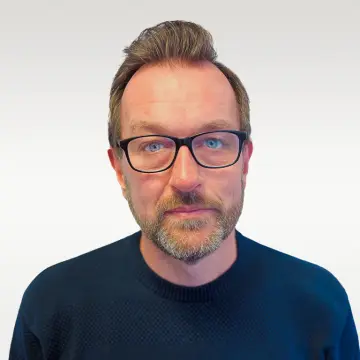
Nordic Sugar's new director sees great opportunities for innovation and green growth. - Our task is to ensure that we are still here for the next 150 years
Jannik Olejas at the sugar factory in Nykøbing. He started as the CEO of Nordic Sugar on January 1.Jonas Højlund
Now larger amounts of biogas are set to flow into Nordic Sugar. The gas pipeline worth one and a half billion, which opened in September, is helping to make life a little easier for the new director Jannik Olejas. From the start, it helps give him and thus the Danish production a green leader's jersey in Nordzucker, which owns Nordic Sugar and thus the sugar factories on Lolland-Falster.
The green transition is important. It is also in demand by the large industrial customers, and thus it is also good business. And good business and development are important for the 54-year-old director.
- I have come home to develop our business - I see lots of interesting potential, says Jannik Olejas.
After four years as the top manager for Mackay Sugar in Australia, he is back in Denmark and ready to make his mark on Nordic Sugar's future. His experiences from Australia and previously from Germany have given him a global understanding of how sustainability and innovation can go hand in hand.
- We have been here for 150 years because we have adapted and seen opportunities in challenges. We must continue to do so. Our task is to ensure that we are also here for the next 150 years, he says.
Jannik Olejas returned home from Australia in November. And now lives in Copenhagen.
- But we have a summer house in Marielyst, he says with a smile.
Sugar on Lolland-Falster
The first sugar factory on Lolland-Falster opened in 1872 in Sakskøbing.
Between 1880 and 1912, 15 sugar factories were established in the area, often located near market towns.
Sugar production is based on beet cultivation, which still constitutes a significant part of the area's agriculture.
Historically, sugar has been known as "Lolland's white gold" and has played a crucial role in both the economy and identity of the region.
Today, there are two active factories on Lolland-Falster - in Nakskov and Nykøbing Falster - that still process local sugar beets.
The sugar factories are now owned by the German company Nordzucker, which is among Europe's largest sugar producers.
Under the 'we' is a family with four children who returned home to Denmark before Jannik did. There were just some loose ends that needed to be tied up in Australia before everything could fall into place, and Jannik Olejas could start the job on January 1st. The permanent office is in Copenhagen, and when he is, for example, in Nykøbing, he doesn't have an office at all but must book an available space like everyone else. Even if you are the CEO. That part seems to suit Jannik Olejas just fine. He is smiling, friendly, and very humble about the job he is now undertaking. And that presence is an important factor when running a large production company.
- I want to be present. It's about understanding the processes and the people who drive them. You learn something new every day, he explains.
Green transition and a new milestone
One of the challenges with producing sugar has been the large CO₂ emissions. Nordic Sugar is the second-largest CO₂ emitter in the industry in Denmark. But with the opening of the gas pipeline to Lolland-Falster, the picture looks different. By switching from oil to gas, CO2 emissions have been significantly reduced. And with the next step, where larger amounts of natural gas are exchanged for biogas, it is expected to reduce CO₂ emissions by up to 37,000 tons annually.
- It is a milestone for both us and the region. We can already see a significant difference in our climate footprint, says Jannik Olejas.
From waste to innovation
Jannik Olejas sees the green transition as more than just a way to reduce CO₂ emissions. It's also about utilizing resources in new ways.
His experiences from Australia have taught him how much potential there can be in thinking about resource utilization and collaboration in new ways.
We see that our customers are becoming increasingly aware of their CO₂ footprint. If we can deliver a more sustainable sugar, we can help them achieve their own climate goals. It is a clear competitive advantage
Jannik Olejas
- In Australia, we worked a lot with utilizing by-products, such as fiber from sugarcane for energy production. We had a close collaboration with an external food producer who could use our infrastructure, so we supplied them with steam and electricity. This has taught me how much value can be created if you think innovatively, he explains.
- Sugar is more than just sugar - it can be a building block for everything from jet fuel to packaging. It's about thinking in new collaborations and finding solutions that make sense both for the environment and the economy, he says.
He points out that Nordic Sugar should not only think green for the sake of the environment but also to meet the increasing demands of customers.
- We see that our customers are becoming increasingly aware of their CO₂ footprint. If we can deliver a more sustainable sugar, we can help them achieve their own climate goals. It is a clear competitive advantage, he explains.
A future on Lolland-Falster
Jannik Olejas sees Nordic Sugar as an important player in the development of Lolland-Falster. He knows how important sugar beets are for Lolland-Falster. It is a part of the area's soul and economy. Two things that should ideally go hand in hand. And in the same breath, he mentions development again.
- It's about always being one step ahead - both in terms of our products and our way of thinking about sustainability.
He emphasizes that Nordic Sugar should be a leader, not just follow suit:
- We should not just go with the flow. We should be the ones setting the standard, both in Denmark and in Europe.