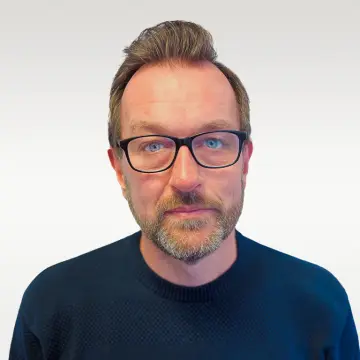
What does the future look like for businesses in the municipalities of Vordingborg, Lolland, and Guldborgsund? FemernBusiness poses this question to the mayors Mikael Smed (Vordingborg), Holger Schou Rasmussen (Lolland), and Simon Hansen (Guldborgsund).
Each mayor has been asked to address three questions about business development in their own municipality, as well as three overarching questions about the region's future growth leading up to and following the establishment of the Femern connection. In Lolland, major changes are already on the horizon. With the development of a new 800-hectare business area at Rødbyhavn and a port that could become a central hub for the green transition, there is potential for thousands of new jobs. Here, the focus is on business development in Lolland Municipality with Mayor Holger Schou Rasmussen (S).
Lolland
Municipality has a large surplus of green energy. How will you strategically use this resource to attract companies that depend on sustainable energy?
- The city council has in recent years had a strong focus on green business development. The green transition should be actively used to create growth and attract new jobs locally, benefiting our local area. Companies with a high energy demand should be located here, where the energy is - and where we also have plenty of space, a high ceiling, and a central location in the new Femern region. At the same time, with our strong logistical infrastructure, we can ensure that companies working with green technologies such as Power-to-X, CO₂ capture, and wind turbine production have optimal conditions for growth and development.
With
the large construction activities around Rødbyhavn and the Fehmarn project, how does
the municipality ensure that local businesses get a share of the tasks and growth?
- We have long had a strong focus in the city council on ensuring that the factory in Rødbyhavn is preserved, even when the Fehmarn construction is finished. Fortunately, that decision was finalized shortly before Christmas in 2023. But our plans are bigger than that; In 2024, we have started developing a gigantic business area north of the factory, where a new business and industrial park of more than 800 hectares can emerge. Or what corresponds to 1000 football fields. In other words, an area with the world's largest concrete factory, a gigantic working port, plenty of surrounding space, and easy access to both railway and motorway centrally in the new Fehmarn region and in the middle of the large transport corridor between Copenhagen and Hamburg, as well as between Scandinavia and Central Europe. An area that can become one of Denmark's five upcoming industrial parks. If successful, it will generate thousands of new jobs and provide a potential exponential development that will affect almost everything. Also the local businesses. And not just in Rødbyhavn and on Lolland, but in a larger geography across all of Lolland-Falster and South Zealand.
The COWI report
shows that the proportion of working-age citizens in Lolland may decline towards 2040.
How will the municipality work on workforce development and education to
counteract this trend?
- In Lolland
Municipality, we see great potential in several areas: First and foremost, the
many additional jobs are our leverage for new growth and development. For every
job is not just a job, it is also a settlement opportunity,
and the many new companies will naturally contribute to attracting new residents.
The COWI analysis has shown that there will be a need for a wide range of
skills, so there will be jobs that can match almost any type of
education or career aspiration.
Furthermore,
we have a strong focus on the international perspective. Many international citizens
are coming to our area these years to work on Femern or in the area's
large international companies, and in Lolland Municipality, we have also had good success
in recent years with recruiting labor internationally. Not
least for our elderly care sector. We hope that many have/will want to settle
down in Lolland, also in a long-term perspective. Our international school
is a roaring success, and we in Lolland have long traditions for warmly welcoming
international newcomers.
How do you see the Fehmarn connection affecting business and trade in the area over the next ten years?
- The Fehmarn connection is a growth dynamo that will impact business development, the labor market, employment, settlement, tourism, and much more. Not just on Lolland, but in a large geographical context and for many years to come. The port in Rødbyhavn can play a crucial role in this development, especially in relation to the offshore wind industry. The deep port allows for handling the large components for offshore wind turbines, which will become a central part of Europe's energy supply. Additionally, the port can function as a logistics hub for the production, assembly, and export of wind turbine parts, which will create new jobs and cement Denmark's position as a leading player in the green energy transition.
Labor is a critical factor for many businesses. How do you solve this challenge across municipal and national borders?
- This requires, among other things, the recruitment of international labor with an increased focus on local integration efforts such as language courses, local training, colleague support, networks, and offers for any accompanying family, such as an international school and a job for the partner. With a strong port infrastructure in Rødbyhavn, there will be opportunities to attract qualified labor from both Denmark and Northern Germany. The direct connection to both Copenhagen and Hamburg means that companies can recruit more broadly, while the port and wind turbine industry create attractive jobs that can retain specialized labor in the area.
Critics say that the Fehmarn Belt connection will not benefit the business community in the Fehmarn region (except for tourism). That it will just be an area you drive through to get from Copenhagen to Hamburg. Are they right?
- No. By exploiting the potential of the infrastructure and combining it with strategic business initiatives, it is ensured that the area becomes an industrial hub and not just a place you drive through. Especially the port in Rødbyhavn will play a central role in this. With the necessary capacity to handle the large constructions required for offshore wind turbines, the port will be able to attract companies in production and logistics. This will not only create local jobs but also ensure that Denmark takes a leading role in Europe's green transition.